
Every creature has a story. In collaboration with historians and museum curators, we explore the history of collections, collectors and taxonomists to locate original specimens (type specimens) collected from Singapore and other neighbouring countries
WORK 05 (2022) JOURNAL ARTICLE
A Fishing cat specimen from Singapore in Leiden, the Netherlands
Fishing cat is not a species known to occur in the Malay Peninsula, but a specimen dated 1819 from Singapore is now housed at RMNH. It was attributed to Diard, one of the French naturalists employed by Raffles for the first Singapore biodiversity expedition (May–June 1819). Raffles didn’t mention any cat species from Singapore in his descriptive Catalogue. In fact, no zoological material from Singapore dating 1819 is known outside England.
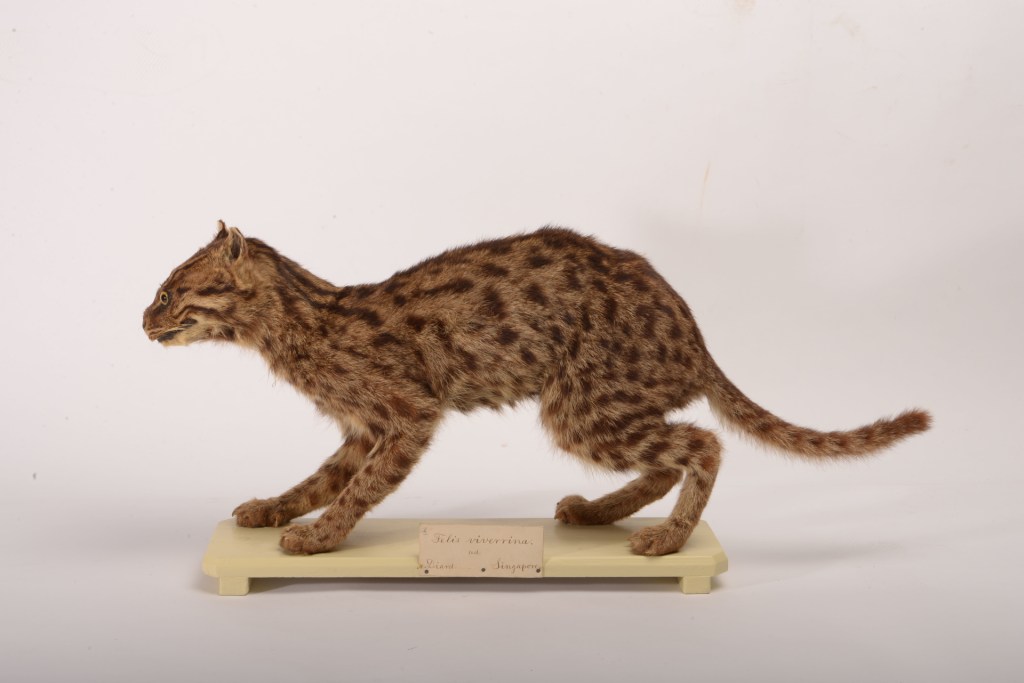
Did Diard play a game of cat and mouse with Raffles?
In 2019 (200 years later), we searched through RMNH collection to locate, photograph and digitally catalogue the specimen. It is now registered as RMNH.MAM.59688: https://data.biodiversitydata.nl/naturalis/specimen/RMNH.MAM.59688.b
We studied four sets of annotations from labels, one of these is a handwritten label pasted on a piece of wood presumably to be in Diard’s handwriting. Due to variations of spellings, we think the specific name on the label (first line) can be interpreted in 3 ways:
- Felis leucojalamus appears in Jentink’s and Brongersma’s catalogue. It’s possible that Jentink may only have glanced at the label and thought Diard had intended to propose a new name but this specific epithet is incomprehensible
- Felis leucopalmis listed as one of specimens sent by Diard to Leiden in March 1830 signed by H. Schlegel. He wrote “Felis leucopalmis du detroit de Singapour”.
- Why can’t it be Felis bengalensis? Perhaps the specimen was part of triplicates that were allowed to be retained by Diard and Duvacel following the separation with Raffles. Another clue is Diard wrote in translation: “it is also found in Cochinchina and Cambodia”.
Regardless of which way we choose to interpret the spellings for the specific epithet, either leucojalamus, or leucopalmis these names are not accepted in any scientific publication (hence nomina nuda). Also using comparative morphometric, we confirmed that RMNH.MAM.59688 is a fishing cat (not a Leopard cat!) which grouped closely with Javan fishing cat specimens rather than those of Indochina.
If this specimen was an imported specimen that Diard acquired in Singapore, it would point towards a pet trade in rare and large animals in Singapore and the region from as early as 1819. By comparing it to Javan Fishing cat skulls, it is possible that RMNH.MAM.59688 may have been traded from Java.
The reconstructed history of Diard’s Singapore Fishing cat specimen suggests that possibly more Singapore specimens of 1819 collection have not yet been discovered. So where to next? England.
PS. I got access to the collection thanks to Menno Schilthuizen who hosted my visit in Leiden and VNM fellowship for funding opportunity (Read this: From Dungun to Leiden
WORK 04 (2019) BOOK
Voyageurs, Explorateurs et Scientifiques
The various chapters of ‘Voyageurs, Explorateurs et Scientifiques’ were written by 18 authors based in France and Singapore. This book is produced in collaboration between the Lee Kong Chian Natural History Museum and the Muséum national d’Histoire naturelle (MNHN) in Paris, France, with the generous sponsorship of the Total Foundation and support of the Singapore Bicentennial and the Embassy of France in Singapore.
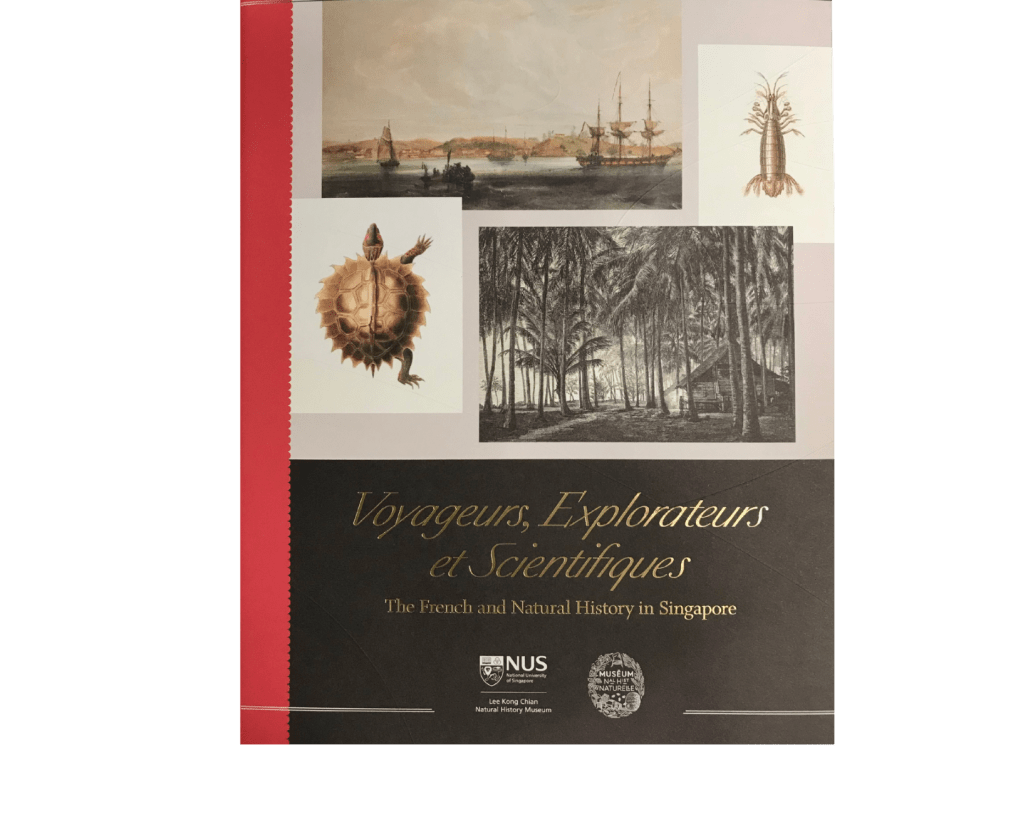
Download the full digital version of the printed book here: Low, Pocklington & Jusoh 2019. More information about the book here
WORK 03 Book Chapter
Chapter 5 Coleoptera: A very special firefly and other beetle stories
A very special firefly is a native Singapore firefly, Pteroptyx bearni, that was described by French entomologist and botanist Joseph Ernest Olivier. The type specimen of P. bearni was collected in 1908 and currently housed in MNHN. This species of firefly has not been sighted in Singapore for a long time.
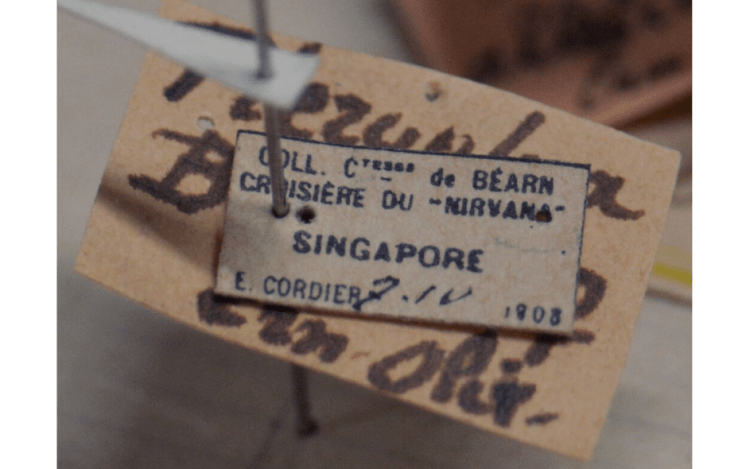
Other beetle stories in this chapter feature Achille Raffray, a French diplomat and Consul in Singapore who had a passion for beetles. He collected many specimens and described more than 80 new species from areas such as Serangoon, Botanic Gardens, Bukit Timah, and Seletar.
For more stories, download the book and see pages 212–233
WORK 02 Book Chapter
Chapter 4 Araneae: Simon’s Singapore spiders
This chapter is about the most prolific arachnologist, Eugène Simon and his work on spiders of Singapore. When I was on the book assignment in Paris, I discovered Simon’s field note which contains his handwritten note on his visit to Singapore dated 5 March 1890. On that trip, he made detailed observations of the web architectures of two Singapore spiders.
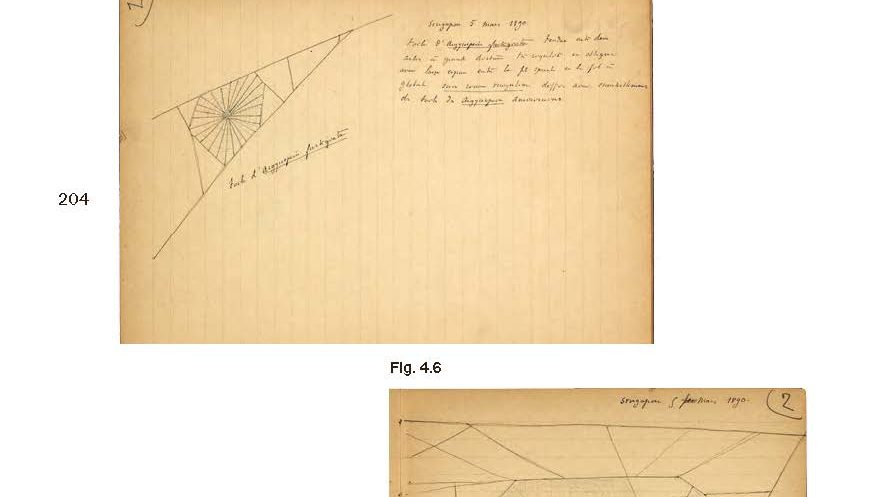
Screenshot of one of drawings by Simon in Chapter 4 Araneae: Simon’s Singapore spiders. Koh et al in Low, Pocklington & Jusoh (2019)
Download the book. See pages 196–211.
Suggested citation: Koh JHK, Jusoh WFA, Hervé C, Leguin E‐A & Ng P (2019) Araneae: Simon’s Singapore Spiders. In: Low MEY, Pocklington K & Jusoh WFA (eds.), Voyageurs, Explorateurs et Scientifiques: The French and Natural History in Singapore. Lee Kong Chian Natural History Museum, Singapore, pp. 196–211.
WORK 01 Appendix
Collectors, ships and expeditions responsible for the deposition of Singapore natural history material at the Muséum national d’Histoire naturelle (MNHN) in Paris
A list of collectors, ships and expeditions responsible for the deposition of Singapore material at MNHN, Paris
Download the book. See pages 382–387.
Suggested citation: Low MEY, Pocklington K & Jusoh WFA (2019) Appendix. Collectors, ships and expeditions responsible for the deposition of Singapore natural history material at the Muséum national d’Histoire naturelle (MNHN) in Paris. In: Low MEY, Pocklington K & Jusoh WFA (eds.), Voyageurs, Explorateurs et Scientifiques: The French and Natural History in Singapore. Lee Kong Chian Natural History Museum, Singapore, pp. 382–38
 WAN JUSOH LAB