
Firefly beetles (Coleoptera: Lampyridae) comprise over 2000 species globally. The subfamily Luciolinae—all of which are exclusively flashing fireflies—represents a diverse subfamily (>400 species) distributed across Europe, Africa, Asia, Australia, and the Pacific islands. The bulk of lucioline species (~303 species) occur in Southeast (SE) Asia and the Australopacific region, which encompasses the following geographic units: India, Sri Lanka, Bangladesh, China (including Hong Kong), Taiwan, Korea, Japan, Myanmar, Laos, Cambodia, Vietnam, Thailand, Malaysia, Singapore, Indonesia, Philippines, the Republic of Palau, the Federated States of Micronesia, Papua New Guinea, West Papua, Solomon Islands, New Caledonia, Vanuatu, Fiji, and Australia*
This is the main focus of our lab research. We work closely with our collaborator and friend, Dr Lesley Ballantyne to explore systematic studies of fireflies in the Luciolinae of SE Asia and the Australopacific region using a broad range of analyses derived from morphological and molecular data, behaviour, and ecology, culminating in taxonomic revisions. Contact me at wanf.ajusoh[at]monash.edu if you’re interested in collaborating with us.
*Jusoh WFA, Ballantyne L, Chan SH, Wong TW, Yeo D, Nada B, Chan KO. Molecular Systematics of the Firefly Genus Luciola (Coleoptera: Lampyridae: Luciolinae) with the Description of a New Species from Singapore. Animals. 2021; 11(3):687. https://doi.org/10.3390/ani11030687
WORK 09 (2024)
A catalogue and redescription of type specimens of fireflies (Coleoptera, Lampyridae, Luciolinae) deposited in Naturalis Biodiversity Center, Leiden
Type specimens of flashing fireflies (Coleoptera, Lampyridae, Luciolinae) in the Naturalis Biodiversity Center, Leiden (RMNH) collection were documented.
WORK 08 (2023)
Description of four new Medeopteryx Ballantyne (Coleoptera, Lampyridae, Luciolinae) species from Thailand and their phylogenetic placements based on mitochondrial DNA
Four new species have been discovered in Thailand, adding to the existing 21 species of the Medeopteryx genus. This genus was originally assigned based on species found in Australia and New Guinea.
WORK 07 (2022)
A new genus for two species of Japanese fireflies having aquatic larvae (Coleoptera, Lampyridae) and a definition of Luciola s. str.
WORK 06 (2021)
Molecular systematics of the genus Luciola with the description of new species from Singapore
The firefly genus Luciola sensu McDermott contains 282 species that are distributed across major parts of Asia, Europe, Africa, Australia, and the Pacific islands. Due to phenotypic similarities, species identification using external morphological characters can be unreliable for this group. In this study, we investigate if “Luciola sp. 2″ is actually a true Luciola and then describe it as Luciola singapura sp. nov. based on observations, morphological data and molecular systematics.
There are now 53 nominal species in the genus Luciola throughout the SE Asian and Australopacific region, including species from Luciola s. str. Laporte and Luciola s. lato sensu Ballantyne.
We expand the definition of Luciola s. str. in this region to comprise 20 species including Luciola singapura Jusoh & Ballantyne, 2021. The provisional inclusion of Luciola jengai, L. papariensis, L. tsushimana, and L. unmunsana may change following future taxonomic investigations.
We formally remove L. cruciata and L. owadai from the genus Luciola and provisionally consider them as incertae sedis (“Luciola”) pending future investigation. Henceforth, all references to the genus Luciola exclude these two taxa.
(UPDATE) Taxonomic revision of “Luciola” cruciata and “Luciola” owadai is now published. Both species are now in a new genus called Nipponoluciola Ballantyne, Kawashima, Jusoh & Suzuki, 2022
WORK 05 (2020)
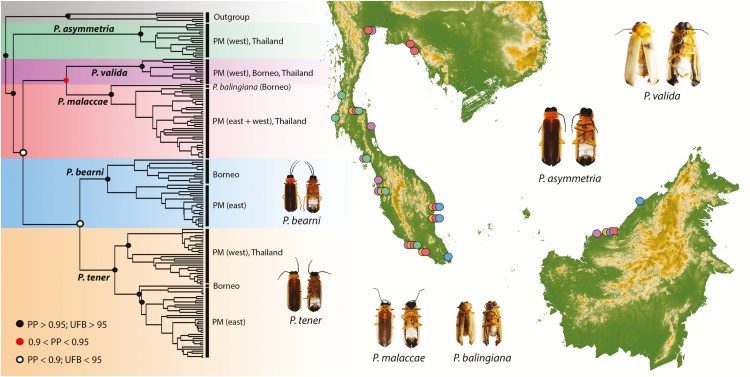
Cryptic and incipient species in Pteroptyx fireflies of Southeast Asia
Synchronous flashing fireflies of the genus Pteroptyx are ubiquitous throughout Southeast Asia, yet fundamental knowledge about their biodiversity is lacking. In this study, we characterised species boundaries within the P. tener, P. bearni and P. malaccae groups. Using a suite of species delimitation analyses, we show that P. tener along the west coast of Peninsular Malaysia is distinct from populations from the east coast and Borneo despite the absence of morphological differentiation.
WORK 04 (2019)
A revisionary checklist of the Luciolinae of S. E. Asia and the Australopacific region

In this monograph led by Lesley Ballantyne, we made overview of the Luciolinae fauna of S. E. Asia and the Australopacific area of Australia, Papua New Guinea, Solomon Islands, New Caledonia, Vanuatu and Fiji. Of the 28 genera now recognised in the Luciolinae we addressed 27 genera from the study area as defined above, including three new genera which are described herein, and 222 species including 13 species newly described herein.
- I am taxonomic author for the following species: (1) Luciola niah Jusoh, 2019. Type locality: Niah, Sarawak (Malaysia); (2) Pygoluciola tamarat Jusoh, 2019. Type locality: Nakhon Sri Tamarat (Thailand)
WORK 03 (2018)
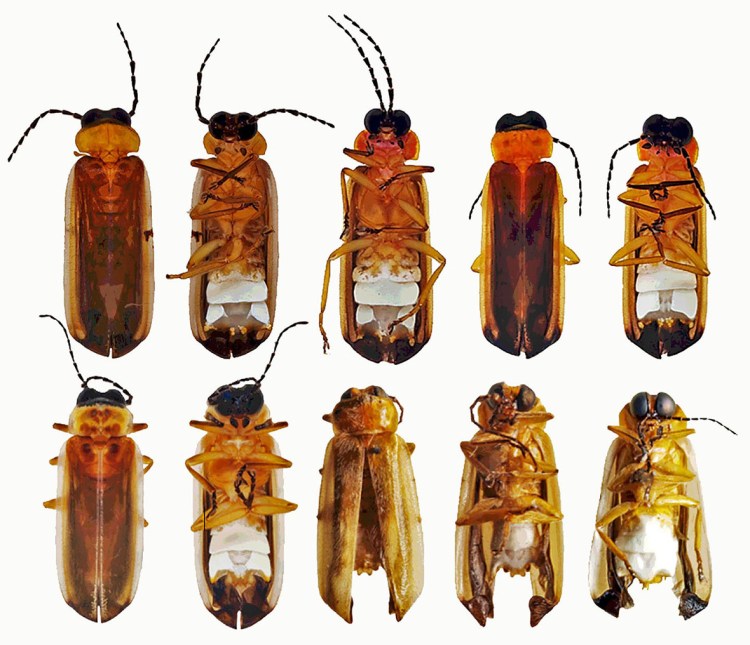
The firefly genus Pteroptyx Olivier revisited
In this monograph, the synchronous firefly genus Pteroptyx Olivier is reassessed from morphological, molecular, and habitat perspectives in Malaysia, and includes some reliably associated females described from morphological features and internal female reproductive anatomy.
- Phylogenetic analyses using combined morphological and molecular data (where available) for 158 taxa supported all the major features of the existing taxonomic categories within the Indopacific Luciolinae.
- Pteroptyx balingiana Jusoh, 2018 was described from Balingian, Sarawak. A second specimen of Pteroptyx gombakia Ballantyne was described and figured.
WORK 02 (2015)
Revisional studies on Luciolinae with 2 new species of the genus Pyrophanes Olivier, 4 new species of Pteroptyx Olivier and description Inflata indica (Motsch.)
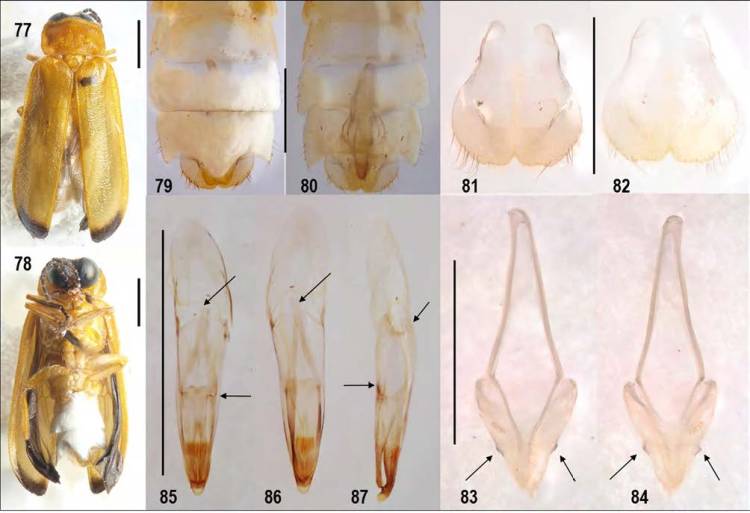
In this monograph, we conducted the following:
- A revision of Pyrophanes including descriptions of two new species
- Rediagnosis and redescription of the genus Pteroptyx and descriptions of four new species;
- A reassessment of the identity of the type species of Pteroptyx, viz. Luciola testacea;
- A description of a new genus Inflata Boontop gen. nov. to which Luciola indica is assigned
Note: Pteroptyx galbina is the first species I described as new to science. Type locality are Niah and Ulu Baram. Both localities are in Sarawak (Malaysia)
WORK 01 (2014)
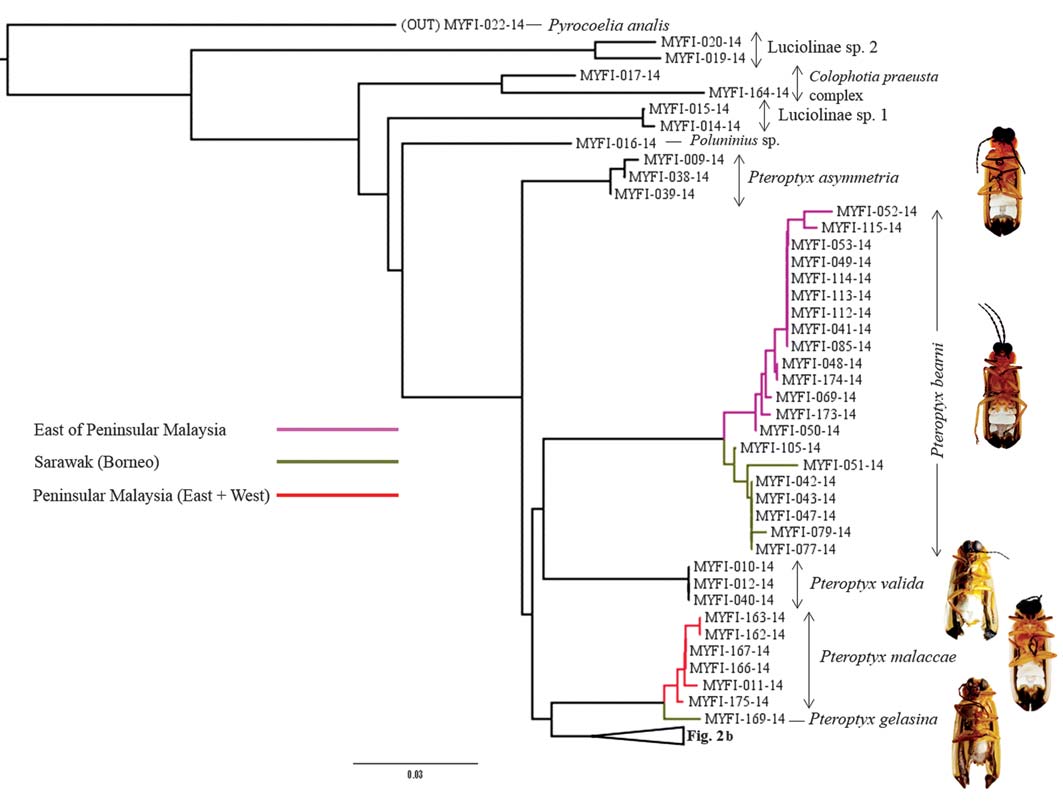
Species delineation of Malaysian mangrove fireflies using DNA barcodes
This study was my first attempt to explore the potential of DNA barcoding to complement morphological identification of fireflies in Malaysia. We demonstrated that the use of DNA barcodes to associate adult females and immature life stages with morphologically identifiable males was successful. The synchronous flashing species, P. tener, clustered into two reciprocally monophyletic eastern and western haplotype groups in Peninsular Malaysia, and the non-synchronous flashing species, P. bearni, clustered into two groups in eastern Peninsular Malaysia and Sarawak.
- Note that further examination revealed that Pteroptyx gelasina in this study was misidentified and later described in Jusoh et al 2018 as Pteroptyx galbina Jusoh, 2018. However, see Work 05 or Jusoh et al. 2020
 WAN JUSOH LAB