
written by Tan Wei Jack
On the 8th of October, we departed at 3:00p.m. from Monash to visit Genting Tea Estate (GTE) located in Genting Sempah, Pahang. The owner of GTE, Dato’ Henry Barlow, had allowed us to conduct a survey on fireflies within his estate. After an hour drive, we stopped by at the Genting Sempah R&R to pack dinner and meet up with Sofwan, one of the researchers residing at GTE. Dato’ Henry Barlow has a keen interest in the various species of moths in Malaysia. As such, he has hired a few researchers to assist him in collecting and preserving moth specimens, Sofwan being one such researcher. After exchanging greetings, Sofwan led our team to an off-road path which led to GTE.
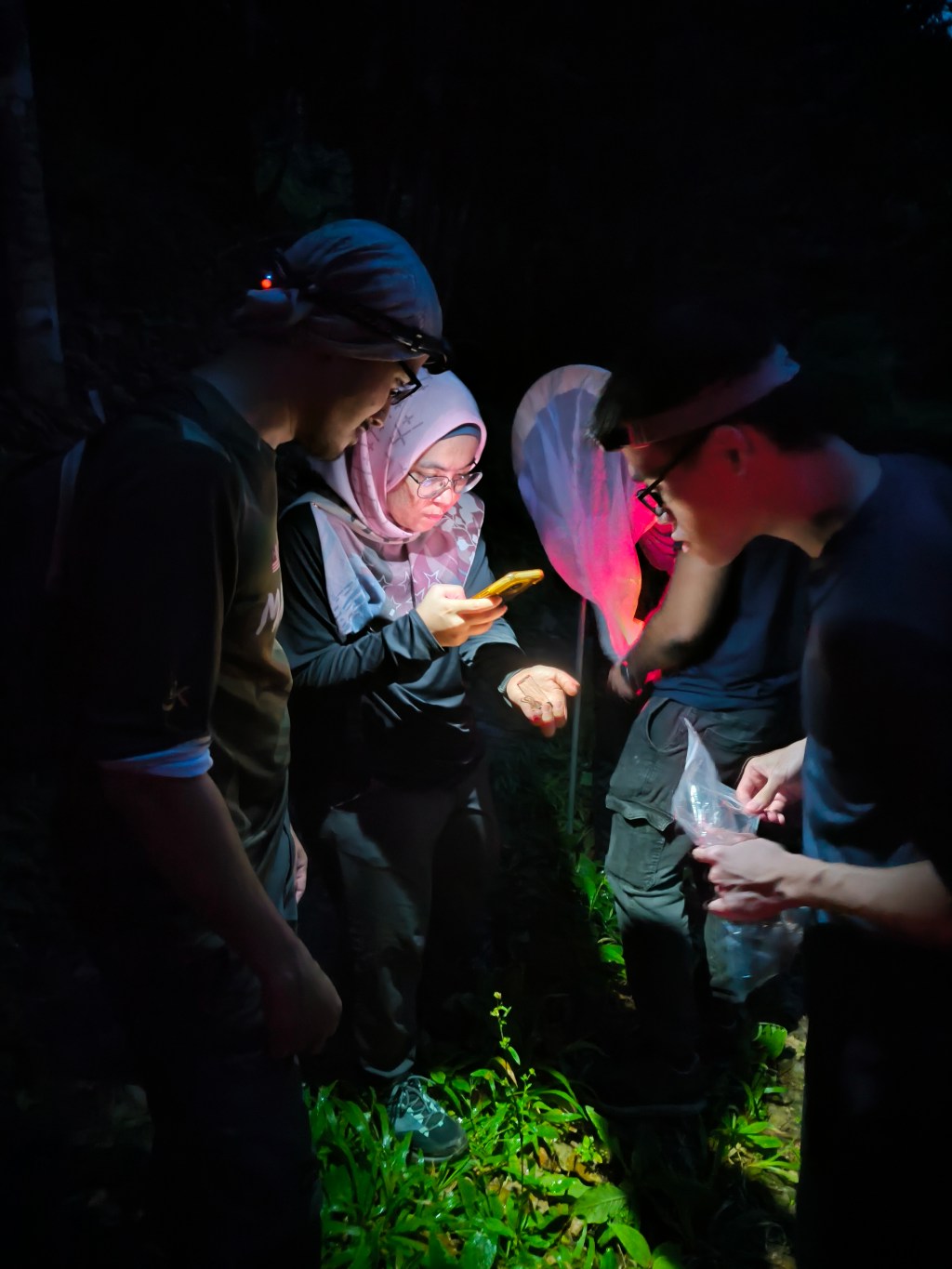
Spanning nearly 100 acres, GTE was located at a quiet hillside rainforest. Apart from a few small buildings and plantations, much of the area was still natural forest. Upon arriving, we dropped off our belongings at the guest house and immediately set off towards the forest. Time was a crucial factor as there was a particular genus of firefly that only appears during twilight. Sofwan guided us through the forest until we reached a clearing where we waited patiently. As the sun set, it did not take long before we started spotting tiny spots of green and yellow light flying among the trees. Using the capture-and-release method, our team managed to identify 5 different genera of fireflies over the next few hours. Unfortunately, our survey had to be cut short due to heavy rain, however it was still a very successful survey.
The next morning, Sofwan brought us to main building where Dato’ Henry Barlow’s moth collection was stored. Over the years, the collection had grown to include thousands of moth species, many of which have yet to be identified and named. These delicate specimens were preserved in cabinets with airtight drawers, each drawer containing dozens of specimens from the 20th century to the present. As we went through each drawer, Sofwan and Khalid, a fellow researcher, shared their knowledge and experiences working with various moths. Sofwan also demonstrated the labelling and photography process for each specimen. Lastly, Sofwan and Khalid showed us how moth species could be identified based on their unique genitalia. Using a microscope, they explained the different genitalia structures and their respective functions. We concluded our visit by taking group photo in front of the main building before returning to Monash.


 WAN JUSOH LAB